Article Archives
Article Categories
Articles
OAOA Recognizes OCAP Recipients


SWO’s New Terminal Available in 2026
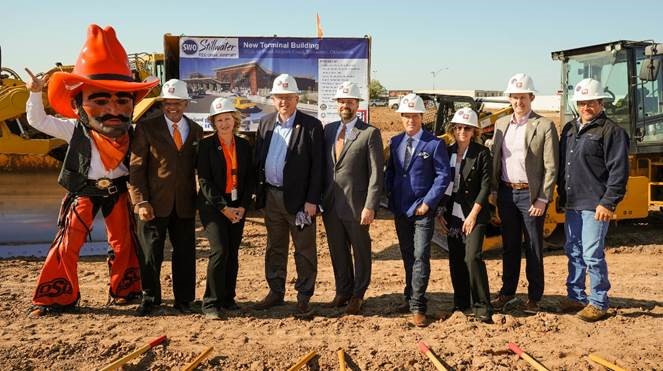
(Stillwater, OK) – Stillwater Regional Airport will enhance flight amenities and options in 2026 through a new 31,375 sq. ft. new terminal that is officially under construction following the groundbreaking ceremony October 1. Federal, state and local officials gathered, along with community leaders and representatives from the aviation community, Federal Aviation Administration and American Airlines to mark the occasion.
“We are elated to be celebrating this monumental development with everyone and for the opportunity to bring a world-class terminal to Stillwater,” Airport Director Kellie Reed said. “We extend our gratitude to American Airlines for eight years of commercial service in Stillwater and we look forward to many continued years of that partnership.”
American Airlines Senior Consultant, Government Affairs Dale Morris said American Airlines wants to see its eight-year partnership with Stillwater Regional Airport continue to grow. The airline wants to provide the right services for the passengers and to ensure OSU, the community and businesses continue to flourish, he said.
Stillwater Mayor Will Joyce addressed the project’s significance to the community and its impact on economic development. The new terminal is the product of many years of effort, he said. The larger terminal will allow Stillwater to increase flight operations and continue to grow the region from which travelers flying in and out of Stillwater Regional Airport are drawn.
Having commercial air service in Stillwater has a significant impact on business and on Oklahoma State University for recruiting staff and students. The new terminal will only enhance that impact, Joyce said.
“It’s hard to overstate how big of a game-changer this is for us,” he said. “We’re so excited and so appreciative of all those who have made an effort to make this happen and are continuing the effort.”
ODAA Director Grayson Ardies emphasized the project’s statewide impact. "The groundbreaking of Stillwater Regional Airport’s new terminal is a significant milestone for Oklahoma's aviation and aerospace industry as a whole,” Ardies said. “This 31,000-square-foot facility will not only support the growth of air transportation for Stillwater but also contribute to our statewide efforts to enhance connectivity and foster economic development. By investing in infrastructure like this, we're ensuring that Oklahoma remains at the forefront of aviation innovation, meeting the needs of travelers and businesses alike.”
OSU Senior Vice President of System Affairs Kyle Wray said Stillwater Regional Airport is critical not just for OSU’s fast-growing aviation program, but for accessibility for the university as it continues to grow and for OSU athletics.
Congressman Frank Lucas also touched on the connection between Stillwater Regional Airport and Oklahoma State University. The university, community and state will all benefit from continued growth and development of the airport, he said.
“Let us not forget, this is a continuing process to expand the potential of this community and of our comprehensive university,” Lucas said. “It’s not just the access to the world that our athletic department needs; it’s the access to the world that our research department needs. It’s the ability of people to come to Stillwater easily, conveniently and quickly to do their business.”
Funding for the $27 million project is provided from partners including the Federal Aviation Administration, the Oklahoma Department of Aerospace and Aeronautics, and the City of Stillwater.
Stillwater Regional Airport is one of only four airports in the state to offer scheduled commercial passenger air service. The new terminal replaces a building constructed in 1952 that was retrofitted for the launch of commercial air service in 2016.
Offering modern facilities with concession space and two gates, the new terminal will serve Stillwater and the surrounding region for decades to come.
“The (new) terminal was beautifully and mindfully designed with both aviation and local Stillwater influences included from the McFarland Architects team,” Reed said.
Phase I of the project consists of the new terminal building, parking lot, and a 4-lane drop off. Further roadway improvements will be in Phase II. Completion of the terminal is expected in August 2026.
|
Left to right: Pistol Pete; American Airlines Senior Consultant, Government Affairs Dale Morris; Stillwater Regional Airport Director Kellie Reed; Congressman Frank Lucas; Stillwater Mayor Will Joyce; Oklahoma State University Senior Vice President of System Affairs Kyle Wray; Stillwater Vice Mayor Amy Dzialowski; Oklahoma Department of Aerospace and Aeronautics Executive Director Grayson Ardies; and Payne County Commissioner Zach Cavett. |
Additional event pictures are available at: https://flic.kr/s/aHBqjBKSA9.
Joby Aviation Showcases Autonomous Flight Technology in Oklahoma City as Part of National Electric Skies Tour
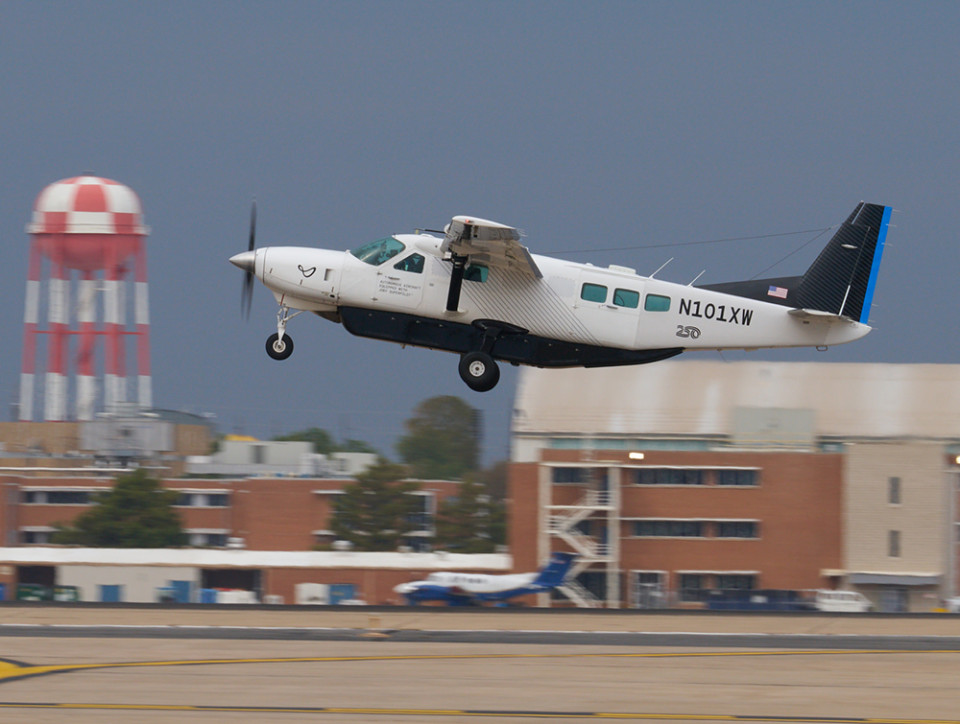
OKLAHOMA CITY – Oklahoma’s role in the future of advanced aviation was on display today as the Oklahoma Department of Aerospace and Aeronautics (ODAA) joined Joby Aviation, federal aviation leaders, and state policymakers for an up-close demonstration of Joby’s autonomous flight technology at AAR Hangar 2 located on the OKC Will Rogers International Airport campus.
The fly-in event served as the Oklahoma stop on Joby Aviation’s 2026 Electric Skies Tour, a coast-to-coast demonstration of the company’s autonomous J208 aircraft. The aircraft, a modified Cessna Caravan equipped with Joby’s autonomous flight technology, is being used to demonstrate autonomous capabilities for commercial, public-service, and defense applications. Joby’s J208 has completed more than 400 flights and 800 automated flight hours and has participated in three U.S. military exercises.
“Oklahoma has built its aviation legacy by being willing to embrace what comes next,” said Grayson Ardies, ODAA executive director. “What we saw today is a real-world example of how rapidly aviation technology is advancing, and why it is important for Oklahoma to be part of that conversation early. By bringing together industry, regulators, policymakers and operators, we can better understand these technologies, help shape how they are safely integrated into our airspace, and position Oklahoma to take advantage of the opportunities they create.”
The event offered attendees a firsthand look at Joby's J208 autonomous aircraft and portable Air Operations Center. Keynote insights from state, federal and industry leaders highlighted the potential applications of autonomous aviation for commercial freight, emergency response and defense logistics. The program concluded with the aircraft taxiing and departing Oklahoma City for the next stop on its national tour.
The Oklahoma City stop follows a major milestone for Joby’s autonomous technology. Earlier this month, the J208 completed a 3,199-mile autonomous transcontinental flight with no control inputs from the onboard safety pilot, including autonomous taxi, takeoff, cruise, and landing under remote supervision, according to Joby.
Oklahoma’s Role in a National Advanced Air Mobility Initiative
The Oklahoma demonstration is connected to the state’s participation in the State of Utah’s uFLY: America’s AAM Crossroads to the West coalition under the FAA’s eVTOL Integration Pilot Program (eIPP).
The eIPP was established to accelerate the safe deployment of Advanced Air Mobility technologies in the National Airspace System through partnerships among government entities and private industry.
Oklahoma is part of the five-state uFLY coalition, and Joby’s Electric Skies Tour includes stops in Utah, Arizona, Oklahoma, and Oregon connected to the coalition. Joby states those operations are designed to evaluate autonomous flight across varied terrain, environmental conditions, and regional airspace while generating operational data that can inform future FAA integration efforts.
State lawmakers, including Sen. Paul Rosino and Rep. Emily Gise, joined federal aviation officials, aerospace industry leaders, and other stakeholders for the demonstration.
FAA Research Connects Oklahoma City to the Future of Flight
The Oklahoma City stop also highlighted the significance of the FAA’s Mike Monroney Aeronautical Center, located nearby, and the advanced aviation research taking place in Oklahoma City.
Dr. Katrina Avers, director of the FAA’s Safe Operations in Aerospace Research (SOAR) Labs, spoke about the FAA’s work to understand how emerging aircraft technologies, increasingly automated systems, human operators, and the National Airspace System interact.
“What makes Oklahoma City especially important to this conversation is that we are not only seeing emerging aviation technologies demonstrated here, but we are also conducting the research needed to understand how those technologies can operate safely within the National Airspace System,” Avers said. “As aircraft become increasingly automated and new operating concepts emerge, we must understand the entire system — the aircraft, the operator, the technology, the procedures, and the human factors involved. That research helps provide the data needed to support safe, thoughtful integration as aviation continues to evolve.”
Putting Autonomous Aviation Into Real-World Operations
Joby’s J208 operates under a supervised autonomy model in which a ground-based remote pilot serves as pilot in command, supervises the flight, updates flight plans, and manages air traffic control communications. A monitoring pilot is onboard for select operations.
View and download images from Joby's 2026 Electric Skies tour stop in Oklahoma City here.
About the Oklahoma Department of Aerospace and Aeronautics
The Oklahoma Department of Aerospace and Aeronautics (ODAA), which operates the Oklahoma Space Industry Development Authority (OSIDA), works to position Oklahoma as a global hub for aerospace, defense, and space industry innovation. Through strategic partnerships, infrastructure investment, workforce training, industry advancement, and statewide advocacy, the agency drives one of Oklahoma’s largest and fastest-growing economic sectors, accelerating the state’s role in commercial aviation, national defense, advanced air mobility, and the emerging space economy. ODAA, through the operation of the OSIDA organization, manages the Infinity One Oklahoma Spaceport, one of the nation’s 14 FAA-licensed spaceports, and leads the development of the emerging Oklahoma space industry.
About Joby Aviation
Joby Aviation, Inc. (NYSE: JOBY) is a next-generation aviation company based in California. Its aircraft, propulsion and autonomy technologies span both commercial aviation and defense applications. Joby also operates Blade, a leading urban air mobility business providing passenger transportation services in the United States and Europe. Joby intends to operate its fast, quiet and convenient air taxi service in cities around the world and sell its aircraft to other operators and partners. To learn more, visit www.jobyaviation.com.
